The effective cross-section
The basic idea
Section titled “The basic idea”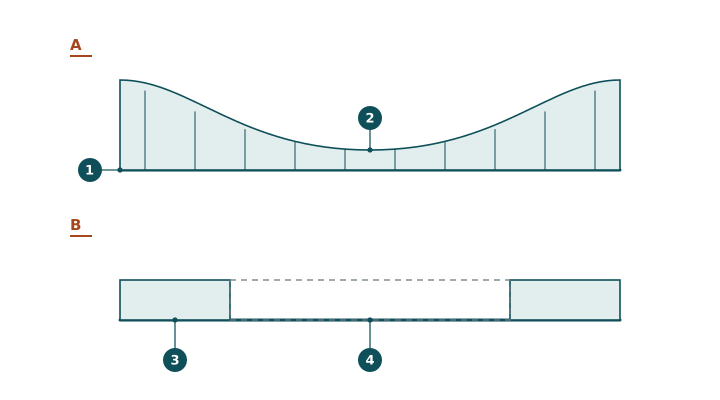
A – real stress distribution, B – the substitute effective widths. 1 supported edge · 2 stress falling away in the middle · 3 the effective part · 4 what drops out of the calculation
After buckling the stress distribution across the plate element is uneven: high near the supported edges, low in the middle.
Design simplifies this: it says that only an effective width of the element works, and it works at full stress — the rest does not count.
The effective cross-section is the reduced cross-section determined this way.
What follows
Section titled “What follows”Capacity is not proportional to area
Section titled “Capacity is not proportional to area”Two sections with the same amount of material can differ greatly in capacity, depending on how “effective” the geometry is.
The effective part depends on the action too
Section titled “The effective part depends on the action too”A compressed member is a different case from a bent one: in bending one half of the cross-section is compressed and the other in tension, and the tension part does not buckle. So the effective cross-section depends on the action.
The shifting centroid
Section titled “The shifting centroid”If part of the cross-section drops out, the centroid of the remainder moves. This produces secondary effects — additional bending in a compressed member, for example — which design accounts for.
Why this cannot be done in your head
Section titled “Why this cannot be done in your head”Because determining the effective cross-section is iterative: the stress distribution gives the effective part, that gives a new stress distribution, and so on. This is why the calculation is done in software, following the expressions in the standard.
That does not mean the designer need not understand it: they have to see what influences the result, so they can steer the structure in the right direction.
What design takes from this
Section titled “What design takes from this”- Lips and stiffeners: they increase the effective part directly.
- Accurate geometry: deviation in the produced section changes the effective cross-section. In-process quality control.
- Restraint: besides improving global stability, it affects the behaviour of the local elements.
The alternative: testing
Section titled “The alternative: testing”Where calculation is too conservative or the geometry is complex, the standard allows design by testing. Design by testing.
The point
Section titled “The point”Because of the effective cross-section, “how much steel is in it” says nothing about capacity. The shape counts at least as much as the quantity.