Section factor and heating
The ratio that decides everything
Section titled “The ratio that decides everything”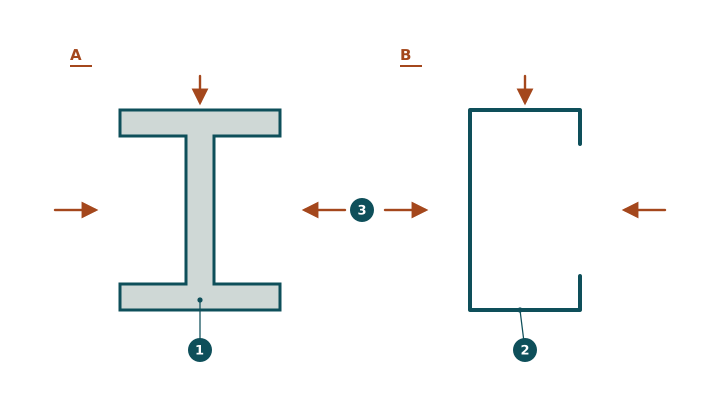
A – solid section, B – thin-walled section. 1 little surface, much material · 2 much surface, little material · 3 the heat exposure is the same in both cases
Steel is non-combustible, but it conducts heat and loses strength when hot. The question is therefore not whether it ignites, but how quickly it reaches the temperature at which it can no longer carry the load.
That speed is described by the section factor: the ratio of the heated surface to the area of the cross-section, that is, to the amount of material. The larger this ratio, the faster the heating.
In a solid, hot-rolled beam there is a lot of steel behind little surface. In a cold-formed section 0.8–1.6 mm thick it is the other way round: large surface, little material. The same heat exposure heats it through much faster.
What happens during heating
Section titled “What happens during heating”Loss of strength
Section titled “Loss of strength”The yield strength of steel falls as temperature rises. Above a few hundred degrees the section no longer has the capacity assumed in the cold design.
Thermal expansion and restraint forces
Section titled “Thermal expansion and restraint forces”The heated member would elongate, but the structure holds it. This creates restraint forces that did not exist in the cold state.
Twisting
Section titled “Twisting”A thin, open section does not move uniformly while heating: the cross-section can twist. Together these lead to stresses large enough for the member to pop out of the wall — even in a place the flame never reached.
What follows for protection
Section titled “What follows for protection”Since the danger is the heating, the aim of protection is for the section to reach the critical temperature later. There are two routes in principle:
- Insulate it from the heat — with a lining that buys time. This is the usual route for light gauge steel walls, but it can only be verified as a system: fire protective boards.
- Protect it with a coating — which works on thick hot-rolled sections but is not a viable route on thin-walled ones: the limits of intumescent coatings.
The third option is not protection but verification: showing by calculation that the structure retains its capacity for the required time. On this: fire resistance design.
The point
Section titled “The point”The section factor is not a theoretical concept: it explains why “steel does not burn” is true, and why “so there is nothing to worry about” is false.