The wall panel as a structure
The parts of the panel and what they do
Section titled “The parts of the panel and what they do”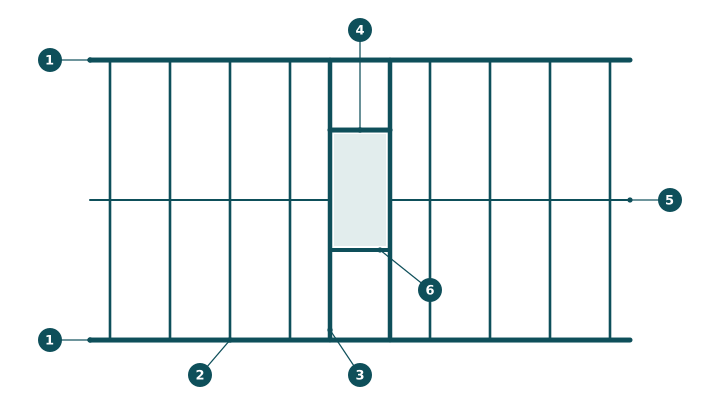
1 bottom and top track · 2 studs · 3 jamb, the reinforced stud beside the opening · 4 lintel · 5 horizontal restraint · 6 the sill member below the opening
They carry the vertical load. Their spacing follows from the load and from what the lining can be fixed to — it is not a free choice.
Bottom and top track
Section titled “Bottom and top track”They tie the studs together, distribute the load and pass it on to the adjoining structures. The bottom track fixes the panel to the substrate, the top track receives the floor or the wall above.
Members beside an opening
Section titled “Members beside an opening”The jamb is the reinforced stud beside the opening that also takes the load from above it; the lintel spans the opening. Openings and lintels.
Restraint
Section titled “Restraint”Horizontal members restraining the studs against buckling and rotation.
Bracing or bracing lining
Section titled “Bracing or bracing lining”Resistance to horizontal loads — wind, and in some cases earthquake.
Why it is a system and not a set of parts
Section titled “Why it is a system and not a set of parts”Because the capacity of each member depends on the others:
- the capacity of the stud depends on the restraint,
- the effectiveness of the restraint depends on the fixing,
- the stiffness of the panel depends on the lining acting with it,
- the transfer of load depends on the track and the connection details.
A wall panel therefore cannot be designed “stud by stud”, and no single member can be swapped out without rethinking the system.
What that means for construction
Section titled “What that means for construction”The lining is a structural element
Section titled “The lining is a structural element”If the design counts on the bracing action of the lining, its type, thickness and screw pattern are fixed. Sheathing diaphragm.
The erection state is a separate question
Section titled “The erection state is a separate question”The panel is weaker before the lining goes on. Temporary bracing is required.
Later intervention is a risk
Section titled “Later intervention is a risk”An opening cut later breaks both the load path and the bracing. Later alterations.
The link with the build-up
Section titled “The link with the build-up”The structural and building-physics roles of the panel are present at the same time: the space between the studs belongs to the insulation, the vapour control layer runs on the inside face, and the lining also does fire and acoustic work.
Designing a wall panel is therefore never a purely structural task.
The point
Section titled “The point”A wall panel works when every part of it is where it should be. “One stud fewer” or “wider screw spacing” is not a small change but a different structure.