Distortional buckling
What happens
Section titled “What happens”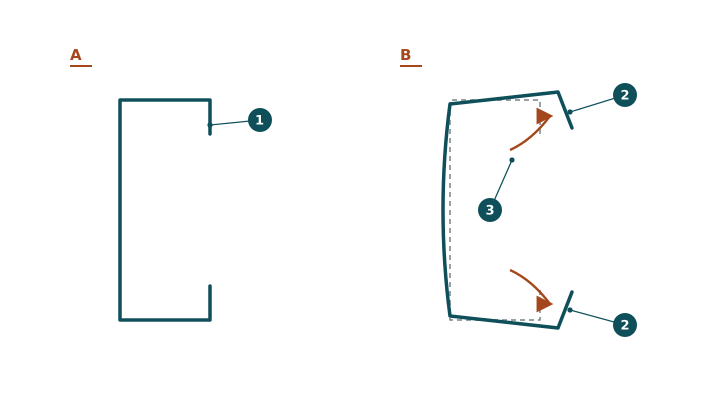
A – original cross-section, B – distortional mode. 1 the lip supporting the flange · 2 the rotated flange–lip unit · 3 the direction of rotation
In local buckling the bends stay in place. In distortional buckling the bend itself moves: the flange rotates out together with the lip, as if turning relative to the web, and the web distorts with it.
The shape of the cross-section changes — hence “distortional”.
Why cold-formed sections in particular
Section titled “Why cold-formed sections in particular”Because they have lips. The job of the lip is to support the flange against local buckling — but in exchange it creates a part that can rotate together with the flange, elastically restrained.
The phenomenon is a side effect of the solution: a section improved with a lip gains a new mode of instability.
Why it is treacherous
Section titled “Why it is treacherous”Nothing points to it
Section titled “Nothing points to it”To an installer or a lay observer there is no sign of it. It does not look like classical buckling.
Ordinary restraint does not stop it
Section titled “Ordinary restraint does not stop it”Lateral restraint — the lining, the bracing — prevents global buckling. It prevents the distortional mode only if it also restrains the flange and the lip.
An intermediate half-wavelength
Section titled “An intermediate half-wavelength”Local buckling has a short half-wavelength, global buckling occurs over the full length of the member. The distortional mode sits between the two, so it can “slip through” between the two extreme cases if design does not treat it separately.
What design can do
Section titled “What design can do”Lip geometry
Section titled “Lip geometry”The length and angle of the lip matter considerably. Too short a lip helps little, too long a lip can itself become unstable.
Flange width
Section titled “Flange width”A narrower flange is less prone to rotating.
Targeted restraint
Section titled “Targeted restraint”Where restraint attaches to the flange — screw-fixed lining on the flange, for example — the distortional mode is limited too. That is a design decision: the fixing pattern of the lining is a structural question.
Stiffening ribs
Section titled “Stiffening ribs”Further subdivision of the cross-section makes distortion harder as well.
In the design
Section titled “In the design”EN 1993-1-3 treats this mode separately, modelling the flange–lip unit as an elastically restrained element. Software does this automatically — the engineer’s job is not to forget to check it, and to enter the restraint conditions correctly.
The point
Section titled “The point”The lip is indispensable, but it brings a new risk. The distortional mode is the one phenomenon that must never be left out of the checks in a thin-walled structure.