Self-drilling screw connections
The failure modes
Section titled “The failure modes”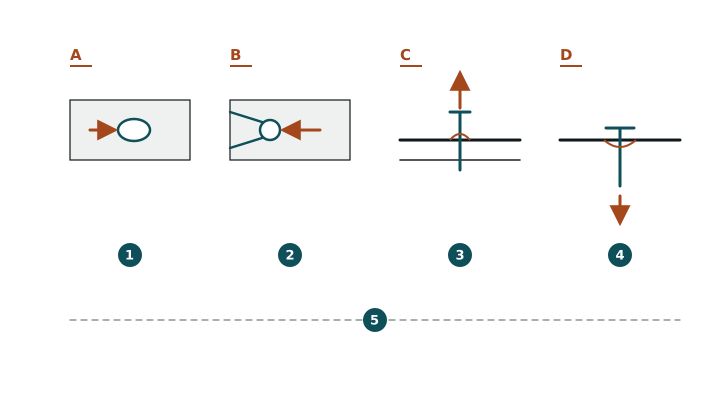
A/1 bearing · B/2 tear-out towards the edge of the sheet · C/3 pull-out · D/4 pull-over · 5 every mode occurs in the sheet, not in the screw
Bearing
Section titled “Bearing”The screw presses on the edge of the hole and the sheet elongates around it. The most common mode, and a relatively “tough” one: it deforms a lot before failing.
Tear-out towards the edge
Section titled “Tear-out towards the edge”If the screw is too close to the edge of the sheet, the sheet tears out. Hence the minimum edge distance.
Pull-out
Section titled “Pull-out”The screw pulls out of the sheet it drilled into. In thin sheet few threads are engaged — critical under tension.
Pull-over
Section titled “Pull-over”The head of the screw pulls through the thinner sheet being fixed. Typical when fixing boards.
Shear of the screw
Section titled “Shear of the screw”The rarer case: the steel of the screw is stronger than the thin sheet.
What follows from this
Section titled “What follows from this”Thickness decides
Section titled “Thickness decides”The capacity of the connection depends first of all on the sheet thickness, not on the size of the screw. Which is often why a thicker section leads to a better connection.
The pattern is designed
Section titled “The pattern is designed”How many screws, at what spacing from each other and from the edge of the sheet. These are not customary values but calculated data.
The type of screw counts
Section titled “The type of screw counts”Thread pitch, head form, drill point, corrosion protection. A “similar” screw is not equivalent. Material pairing and corrosion.
The quality of the work
Section titled “The quality of the work”Driving
Section titled “Driving”A screw driven too loose does not work; one driven too tight strips the thread in the sheet. Both reduce capacity.
Squareness
Section titled “Squareness”A screw driven at an angle has lower capacity and damages the sheet as well.
The missing screw
Section titled “The missing screw”The most common and the most invisible fault. The number of screws in a connection is a designed value — leaving two out is not “nearly the same”.
So connections have to be checked before the lining goes on. Inspection points.
In fire
Section titled “In fire”The connection weakens as it heats while new forces appear from thermal expansion. Fire design therefore has to extend to the connections. Connections in fire.
The point
Section titled “The point”The screw is rarely the weak point — the sheet is. So designing a connection is about sheet thickness, edge distance and pattern, not about screw size.