Façade build-ups
The three main routes
Section titled “The three main routes”Rendered system
Section titled “Rendered system”Render applied over the insulation or the board layer. A simple, continuous surface with good value for money.
Its risk: the outermost layer is soft and more vulnerable to impact, and the quality of the layer behind it decides. Which is why we put the hard board layer outside — a doubled wall with cement board on the outside — so that the outermost layer is impact-resistant rather than the insulation.
Ventilated cladding
Section titled “Ventilated cladding”A cavity runs behind the cladding, draining moisture and heat load. Durable and easy to repair, but:
- more expensive,
- it raises fire questions because of the cavity, Fire spread on façades,
- the fixings can form thermal bridges.
Heavy cladding
Section titled “Heavy cladding”Brick, stone or other heavy cladding on its own support. Traditional in appearance, but the structure has to carry the weight of the cladding too, and the connections have to be designed.
What has to be solved in every case
Section titled “What has to be solved in every case”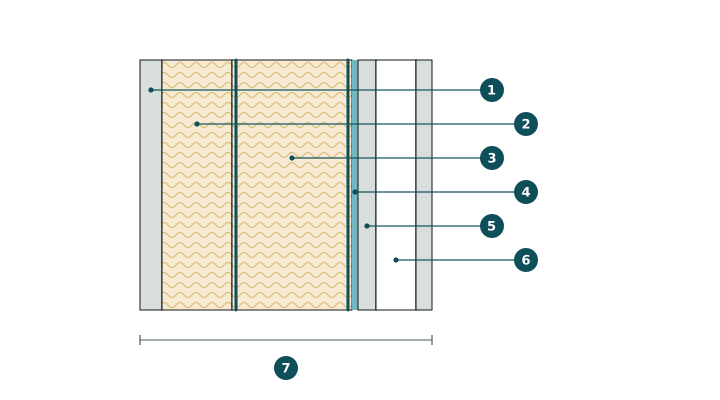
1 external hard board layer · 2 continuous insulation · 3 load-bearing frame with insulation between · 4 vapour control membrane · 5 fire-rated board · 6 service cavity and internal lining · 7 the overall wall thickness
The vapour order
Section titled “The vapour order”The build-up should become more vapour permeable outwards. Wind barrier and breather membranes.
Drainage
Section titled “Drainage”Where the water that gets behind the cladding goes. Critical around windows and doors and at the plinth above all.
Freedom from thermal bridges
Section titled “Freedom from thermal bridges”Handling the fixings and the elements that break through.
The fire requirement
Section titled “The fire requirement”Material class and cavity barriers, depending on height and risk class.
What the technology adds
Section titled “What the technology adds”The framed structure does not constrain the appearance of the façade: render, timber, metal, ceramic or brick can all go onto the same structure. That also makes it easier to satisfy local townscape expectations.
At the same time every change to the build-up has thermal and moisture consequences — so choosing the façade is not the last step.
The point
Section titled “The point”The façade is not “cladding on the structure” but the closure of the build-up. The appearance is free; the physics behind it is not.