Flexural-torsional buckling
The geometric reason
Section titled “The geometric reason”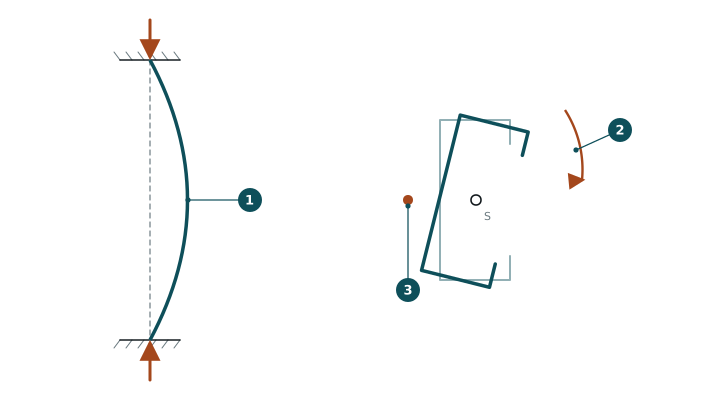
1 the lateral deflection · 2 the rotation of the cross-section · 3 the shear centre, which does not coincide with the centroid
A C section is an open cross-section: not a closed tube but an “opened up” shape. The torsional stiffness of such sections is orders of magnitude lower than that of a closed one.
On top of that, a C section is not doubly symmetrical: its shear centre — the point where a transverse force acts without causing twist — does not coincide with the centroid.
It follows that buckling of the compressed member is not pure bending but a combination of bending and twisting.
What that means in practice
Section titled “What that means in practice”Capacity is lower than pure flexural buckling would suggest
Section titled “Capacity is lower than pure flexural buckling would suggest”Which is why the classical buckling check on its own is not enough.
Restraint is critical
Section titled “Restraint is critical”If the member is restrained laterally and against twist, capacity rises considerably. Hence:
- the lining and the horizontal restraint members in a wall panel are not secondary,
- the spacing of the restraints is a direct design parameter.
Restraint and restraint points.
Eccentricity counts
Section titled “Eccentricity counts”If the load does not act at the centroid — a floor joist delivering its load onto the flange, say — twist is present from the start. The detail of the connection is therefore a design question.
What design can do
Section titled “What design can do”Boxed sections
Section titled “Boxed sections”Two C sections back to back or nested give a more closed, more symmetrical cross-section with far better torsional behaviour. Under concentrated loads this is the standard solution. Built-up sections.
Closer restraint
Section titled “Closer restraint”Simple and cheap: reduce the free length.
Introduce load near the centroid
Section titled “Introduce load near the centroid”Where possible, detail the connection so that no unnecessary twist arises.
In the design
Section titled “In the design”The Eurocode covers torsional buckling within the checks on compression members, and EN 1993-1-3 gives supplementary rules for cold-formed sections. Software does this — the engineer is responsible for entering the restraint conditions correctly, because the result stands or falls on them.
The point
Section titled “The point”An open section twists. Talking about the capacity of a thin-walled column without knowing its restraint is therefore meaningless.