Slab edge: thermal bridge and insulation
Why this point is difficult
Section titled “Why this point is difficult”In a well-insulated building the insulation of the walls and the roof forms a continuous envelope. That envelope opens up around the foundation: something has to go under the wall that carries load and connects to the foundation.
But the foundation touches the ground, so it is cold. If the insulation is interrupted here, continuous heat loss follows — and, more importantly, the internal surface cools down.
The two consequences
Section titled “The two consequences”Heat loss
Section titled “Heat loss”The thermal bridge takes energy away. In a well-insulated building that is proportionally a significant item, because the other surfaces are good.
Condensation and mould
Section titled “Condensation and mould”Vapour can condense on the cold internal surface. Mould appearing around the skirting classically comes from here — not a ventilation fault but a structural one.
In light gauge steel that is a corrosion risk too, because the moisture appears near the structure. Corrosion and service life.
The direction of the solution
Section titled “The direction of the solution”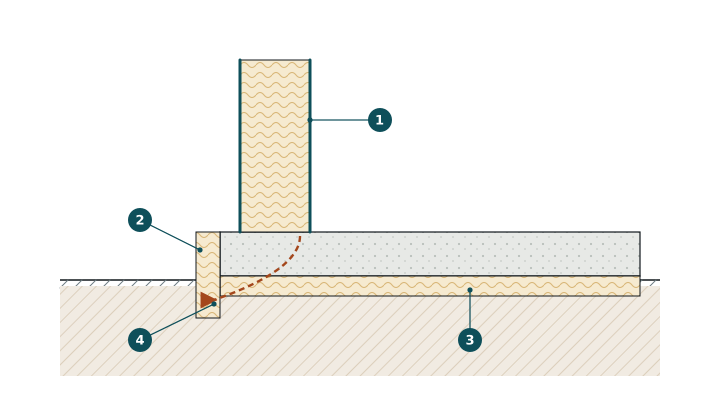
1 the insulation of the wall · 2 edge insulation at the perimeter of the slab · 3 insulation beneath the slab · 4 the heat path if the insulation layers do not meet
Edge insulation
Section titled “Edge insulation”Vertical insulation beside the foundation or the edge of the slab, breaking the heat path.
Insulation beneath the slab
Section titled “Insulation beneath the slab”Where the floor sits on the slab, full-area insulation beneath it.
A thermal break layer under the wall
Section titled “A thermal break layer under the wall”A load-bearing insulating component beneath the bottom track, separating the structure from the cold foundation. It carries load, so it is a structural design question too.
Continuity of insulation
Section titled “Continuity of insulation”The aim is always the same: the insulation of the wall and that of the foundation should meet, with no interruption left.
What complicates it
Section titled “What complicates it”- the damp-proofing runs here too,
- this is where the tolerances are taken up,
- the hold-downs go here,
- and this is the ground connection, which loads the insulation mechanically as well.
Work this junction out on a detail drawing. Leaving it to the site is the most expensive solution. Fixing the bottom track.
The point
Section titled “The point”The quality of the insulation is decided at the junctions, not on the surfaces. The lowest junction is the point at which most well-meant insulation stops.