The steel thermal bridge
The problem
Section titled “The problem”The thermal conductivity of steel is orders of magnitude higher than that of insulation or timber. If a steel section reaches through the full thickness of the wall — from the internal lining to the external layer — it forms a short circuit for heat.
The effect is twofold:
- heat loss: considerably more heat leaves along the sections,
- a cold surface: the internal surface is colder on the line of the section, which is a condensation and mould risk.
This is one of the genuinely sensitive points of the technology — not because it is a bad structure, but because this part has to be taken seriously.
The principle of the solution
Section titled “The principle of the solution”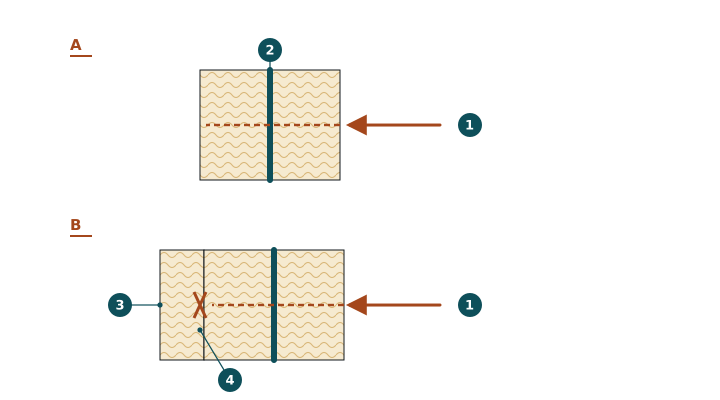
A – insulation between the studs only, B – a continuous external layer. 1 direction of heat flow · 2 the heat path through the section · 3 the continuous external insulation · 4 the interrupted heat path
Do not insulate only between the studs. If the insulation forms a continuous layer outside the sections, the section does not reach through and the thermal bridge effect drops to a minimum.
This is the only genuinely effective solution; everything else is mitigation. Continuous external insulation.
Further tools
Section titled “Further tools”A thermal break layer
Section titled “A thermal break layer”A low-conductivity layer between the section and the lining reduces the transmission.
Cross battening
Section titled “Cross battening”If the internal lining goes onto battens running perpendicular to the sections, the direct contact is broken and the service cavity is formed at the same time.
The geometry of the section
Section titled “The geometry of the section”Ribbed and slotted-web solutions lengthen the heat path. They exist, but they also affect structural behaviour, so they are a design question too.
What to know about the calculation
Section titled “What to know about the calculation”The U-value of a framed structure cannot be calculated with the simple layer formula, because the sections interrupt the homogeneous layers. There are separate procedures for this. Calculating the U-value of a steel frame.
What we see in practice
Section titled “What we see in practice”A badly handled thermal bridge shows on the finished building: the façade is striped on a thermal camera, the line of the sections draws itself on the internal surface as a dusty stripe, and in extreme cases that is where mould appears.
Handling thermal bridges is therefore not a thermal nicety but a durability question.
The point
Section titled “The point”The thermal bridge in a steel frame is real and entirely manageable: it comes down to the continuity of the insulation. Insulate only between the sections and you are building in the technology’s greatest weakness.