Section types and what they are for
Why the shape matters
Section titled “Why the shape matters”With a thin-walled section the shape is a stability question. From the same amount of material, a cross-section whose plate elements are short and supported carries far more — that is what the lips, the bends and the web stiffeners are for.
So choosing a section is engineering, not taste.
The basic types
Section titled “The basic types”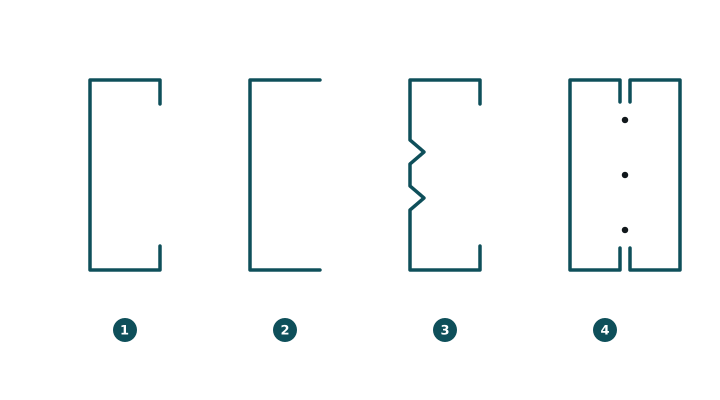
1 lipped C section · 2 unlipped U track · 3 stiffened-web section · 4 built-up, boxed section
Lipped C section
Section titled “Lipped C section”The most common load-bearing member: wall stud, floor joist, truss member. The web gives the depth, the flanges the bending stiffness, and the lips support the flange so that it does not rotate.
Leaving off the lip looks like a saving on material; in reality it cuts capacity significantly.
Unlipped U section (track)
Section titled “Unlipped U section (track)”The bottom and top track of the wall panel, into which the studs fit. It does not primarily work in bending: it holds the frame together and transfers loads.
Stiffened-web sections
Section titled “Stiffened-web sections”At greater web depths the web alone would become slender, so it is broken up by longitudinal stiffening. This increases the effective cross-section.
Built-up, boxed sections
Section titled “Built-up, boxed sections”Two C sections nested or back to back. Used where loads are concentrated: the stud beside an opening, a heavily loaded wall section, a joist end. Built-up sections.
Secondary profiles
Section titled “Secondary profiles”Trims, bracing straps, header members, brackets. These are not incidental: bracing and connection details often depend on them.
What we weigh when choosing a section
Section titled “What we weigh when choosing a section”- What action — compression, bending, or a combination.
- Over what length it works unrestrained.
- How thick the material can be on the available production line.
- What build-up it has to fit — the section depth provides the space for insulation.
- How it connects to the other members.
The limit set by production
Section titled “The limit set by production”The machine’s profile set determines which sections can be produced. The design has to know this, otherwise a section ends up on the drawings that the production line cannot make. The machine range.
The point
Section titled “The point”The lip, the stiffening and the bends are not decoration: they are what keeps the sheet from folding. In a thin-walled structure the shape is the capacity.