Local buckling
What happens
Section titled “What happens”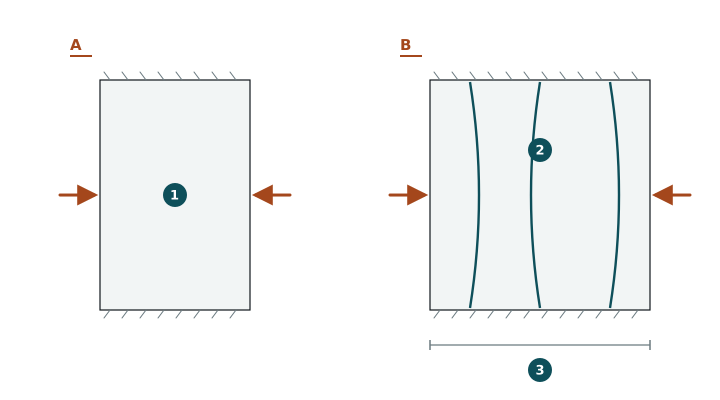
A – stocky element, B – slender element. 1 the element stays straight · 2 the buckling waves · 3 the width of the element, which relative to thickness decides the behaviour
If a thin, wide plate element is compressed in its plane, at some point it deflects sideways: waves appear across it. The bends — where the sheet turns into another plane — support the element, so they stay in place.
Note: buckling is not failure. The buckled plate carries on carrying load, just unevenly: fully near the supported edges, far less in the middle.
Why it happens early
Section titled “Why it happens early”The stability of a plate element depends on the ratio of width to thickness. The more slender the element, the lower the stress at which it buckles.
A flange a few centimetres wide formed from 1 mm sheet is slender in this sense — so buckling typically occurs before the yield strength is reached.
How design handles it
Section titled “How design handles it”With the concept of effective width: design does not work with the real, uneven stress distribution but with a reduced, “effective” cross-section that gives the same capacity. Effective cross-section.
What design can do about it
Section titled “What design can do about it”Stiffening lip
Section titled “Stiffening lip”A lip bent onto the free edge of the flange supports the element and improves its stability considerably. That is why load-bearing C sections have lips — and why leaving them off is a serious loss.
Stiffening ribs
Section titled “Stiffening ribs”A longitudinal rib divides a large web into two smaller elements. Two slender elements become four stockier ones.
Narrower elements
Section titled “Narrower elements”A shallower web or a narrower flange gives stockier elements — at the cost of bending stiffness. Design optimises between the two.
Thicker material
Section titled “Thicker material”Directly improves the stability of the element.
What it means in practice
Section titled “What it means in practice”Buckling explains why you cannot tell by looking what a profile carries, and why knowing the thickness is not enough. Two sections of the same depth and thickness can differ significantly in capacity if one has a lip and stiffening and the other does not.
The point
Section titled “The point”Buckling is not a defect but the nature of thin sheet. Design does not try to eliminate it but to manage it — with restraint and with the effective cross-section.