The service cavity
Why not in the structure
Section titled “Why not in the structure”Machine makers like to advertise that holes can be cut in the profile for cables, and many people take them up on it. We do not recommend it, for two reasons.
Fittings exist on paper for sealing a penetration through the structure. In practice they are almost never installed because of the cost — so the solution exists on paper and not in the wall.
Vapour control
Section titled “Vapour control”This is the more serious one. In light gauge steel construction vapour control is done solely by the membrane. Puncture that envelope anywhere and moisture will collect there — and the 65 mm hole drilled for every light switch is exactly such a puncture.
What we recommend instead
Section titled “What we recommend instead”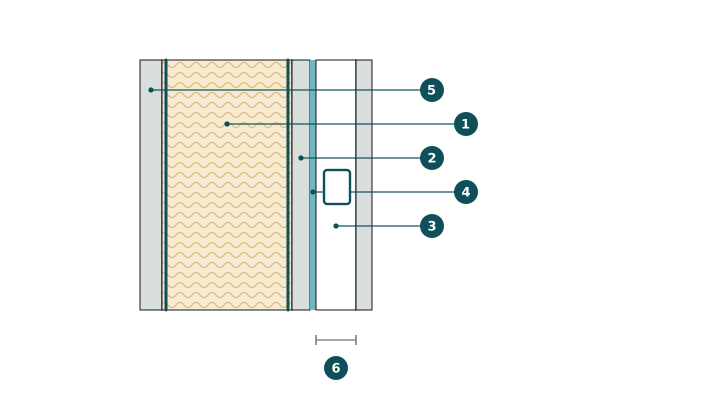
1 load-bearing frame with the insulation · 2 fire-rated board · 3 socket box in the service cavity · 4 the intact vapour control membrane · 5 external hard board layer · 6 the 30–40 mm depth of the service cavity
Fire-rated board and the vapour control membrane go on the inside face of the structure, and the mechanical and electrical installation runs inside that, in a second plane formed with battens.
This is not a full lining wall — it can be done with plasterboard or profile battens — so it is substantially cheaper than one.
What it gains
Section titled “What it gains”- The vapour control membrane stays intact.
- The sound insulation improves, because the layer decouples.
- At a later strip-out — if something has to be routed or repaired — only the inner board has to be opened, not the structure, the insulation and the membrane.
- The thermal bridge is reduced, because the lining does not bear directly on the section. Ways of breaking a thermal bridge.
What it costs
Section titled “What it costs”30–40 mm of space across the whole wall.
Where a larger-diameter waste pipe has to be run, one or two short stretches need a genuine lining wall — with well-designed services that is a few square metres in a whole house.
And in cost it is not necessarily dearer than the profile solution, because nothing has to be punched through the profiles.
What to watch in the design
Section titled “What to watch in the design”- the depth of the service cavity should suit the diameter of the cables,
- the socket boxes belong in this plane, not in the membrane,
- the route of large-diameter soil stacks has to be fixed early,
- the acoustic role of the plane can be exploited with resilient fixings.
The point
Section titled “The point”The service cavity solves three problems at once: vapour control, sound insulation and later access. It is the best value-for-money decision in the build-up.